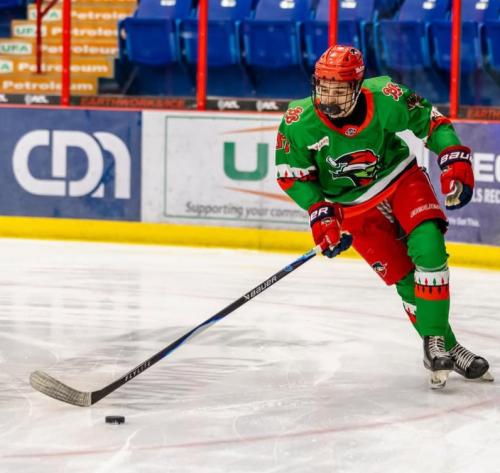
The off-season is where prospects are made. Every rep, meal, and hour of sleep this summer shows up on the ice in September. This hub is the daily system: train, eat, recover, get seen.
🏒 Ask Coach
His AI development coach, on call. Training questions, D-zone habits, what to eat before a showcase, how to email a junior coach — it knows his profile and his goal. Tap to talk.
Daily execution — check it off
Current streak: 0 days • 0/6 today
Four or more checks = a pro day. Never miss twice.
This week's focus
Built to be seen by scouts and junior coaches — print to PDF (Cmd+P) or send as a link. Fill every [bracket] before sharing.
Defenseman • Class of 2026
Nikita Bogatyrev
#2 — St. Joseph High (Montvale) • USHS-NJ • New Jersey
Two-way left-shot defenseman out of New Jersey high school hockey. [2–3 sentences on his game — write these with his coach: e.g., skating, gap control, first pass, physicality, hockey IQ. Honest and specific beats hype — scouts can tell.] Committed to the daily work: structured off-season strength program, on-ice skills development, and a junior route targeted at NCAA hockey.
Highlight Video
[Add YouTube/Veo link] — 3–4 minutes max: best 15–20 shifts, defense first (gap control, breakouts, first pass, net-front battles), a few offensive touches at the end. Jersey #2 circled at the start of each clip. This link is the single most important line on this page.
Season Stats
2025–26 — St. Joseph High (Montvale), USHS-NJ: [GP] games, [G] goals, [A] assists, [special teams role]. [Team result — e.g., league/county playoff run.] Full history on Elite Prospects.
Academics & Character
Academics: [GPA / honors / SAT if strong] — junior and college coaches recruit students first.
Off-ice: [work ethic proof — training schedule, jobs, volunteering, captainships].
Built for a 5'11" / 176 lb defenseman whose next 10 lbs of muscle and next gear of speed decide his junior year. Four lifts + two conditioning days + one full rest day. Have a qualified trainer check his form on the big lifts; this plan is a framework, not medical advice.
The goal by September
176 → 185 lbs of functional muscle • stronger first three steps • harder shot • wins more net-front and wall battles. Defensemen get recruited on skating and strength — this plan feeds both.
Day
Session
Mon — Lower Strength
Back or front squat 4x5 • Romanian deadlift 3x8 • Bulgarian split squat 3x8/leg • Nordic curls 3x6 • weighted planks 3x45s
Tue — Upper Strength
Bench press 4x5 • weighted pull-ups 4x6 • single-arm DB row 3x10 • overhead press 3x8 • farmer carries 3x40yd • band shoulder care
Incline DB press 3x10 • chin-ups 3xAMRAP • face pulls 3x15 • curls/triceps superset 3x12 • neck work 3x15 (concussion insurance)
Sat — Conditioning + Ice
Bike intervals 10x30s hard / 90s easy (mimics a shift) • skills session, stickhandling, 100 shots minimum
Sun — OFF
Full rest. Walk, stretch, 9 hours of sleep. Growth happens here.
On-ice (non-negotiable all summer)
2+ skates/week: power-skating or defense-specific skills coach if possible — skating is the #1 thing junior scouts grade a D on.
100 shots/day from the blue line — wrist and slap, head up, walking the line.
10 min/day stickhandling (golf ball on concrete works).
Rules
Add weight only when all sets/reps are clean. Form first, ego never.
Track every lift in a notes app — progressive overload is the whole program.
Deload every 5th week (same lifts, 60% weight).
In-season (from Sept): cut to 2 lifts/week, maintain, prioritize sleep.
Nutrition Plan
The lifting only works if the eating matches it. Target: lean weight gain — roughly 176 → 185 by fall. General athlete guidelines; run it past his doctor or a sports dietitian, especially before adding any supplement.
~3,400
CALORIES / DAY
160–175g
PROTEIN / DAY
400g+
CARBS ON TRAINING DAYS
3–4L
WATER / DAY
The day, roughly
Breakfast: 4 eggs + oatmeal with banana and peanut butter + glass of milk.
Lunch: big protein + rice/pasta/potatoes + vegetables. Chipotle-style double-protein bowls are perfect.
Pre-lift (60–90 min before): carbs + some protein — bagel with turkey, or Greek yogurt with granola.
Post-lift (within an hour): protein shake + fruit, or chocolate milk — the old-school recovery classic works.
Dinner: another full plate — protein the size of his hand x2, carbs, vegetables.
Before bed: Greek yogurt or cottage cheese (slow protein overnight).
Game/showcase day
3–4 hrs before: big carb meal — pasta with chicken, rice bowls. Nothing new, nothing fried.
60–90 min before: light — banana, granola bar, sports drink.
Between games at showcases: sandwiches, fruit, chocolate milk, electrolytes — pack a cooler, never rely on rink food.
Supplements — short list only
Whey protein: convenience, not magic — food first.
Creatine monohydrate (5g/day): the most-studied supplement in sports, well-supported for strength in athletes his age — but clear it with his doctor first, and buy third-party tested (NSF Certified for Sport).
Vitamin D in winter. That's the whole list — everything else is marketing.
The two that outrank everything
Sleep: 8.5–9 hours, same schedule. It's when muscle is built and skills consolidate — the single biggest legal performance enhancer. Hydration: pale-yellow test. A 2% drop in hydration is a measurable drop in skating power.
The Path — HS to Junior to College
Born 2008 means junior eligibility through age 20 — there is time, and the road is well-marked: junior hockey in 2026–27, develop, get seen, NCAA or ACHA after. Thousands of players walk it every year; the ones who make it treat exposure like a second sport.
The ladder (NJ/Northeast reality)
Tier 3 junior — EHL, USPHL Premier: the realistic 2026–27 entry point from NJ high school hockey. Pay-to-play, but real development and real NCAA D3 placement records. Look hard at each team's "alumni/commitments" page before choosing.
Tier 2 — NCDC, NAHL: tuition-free; make one of these by 19–20 and NCAA D3 (and outside-shot D1) doors open. NAHL runs open tryout camps every spring/summer.
College: NCAA D3 hockey in the Northeast is deep and excellent; ACHA D1/D2 club hockey (many big universities) is a great hockey+school combination. Junior performance, not high school stats, is what gets players placed.
Get seen — the exposure system
Claim and update the Elite Prospects profile — coaches actually check it. Add stats, current team, and the highlight link. (There's a "Claim profile" button on his page.)
Build the 3–4 minute highlight reel — defense-first clips. Post to YouTube, link it everywhere.
Email 15–20 junior coaches directly (template below). Coaches answer short, specific emails from players — not from parents. Send from Nikita's email, always.
Hit 2–3 tryout camps (spring/summer): target USPHL and EHL team camps plus one NAHL open camp — camps are auditions AND scouting networks.
Showcases: one or two quality ones beat five mediocre ones. Ask his current coach which ones the target leagues actually attend.
Email to a junior coach — the template that gets answered
Subject: Nikita Bogatyrev — '08 LD, St. Joseph (Montvale) — 2026-27

Coach [Name],

I'm Nikita Bogatyrev, an '08 left-shot defenseman from St. Joseph High (Montvale) in New Jersey — 5'11", 176, two-way game built on skating and a good first pass.

I'm targeting [League/Team] for 2026-27. Highlights: [YouTube link]
Elite Prospects: eliteprospects.com/player/617414/nikita-bogatyrev

I train 6 days a week and I'll be at [camp/showcase] on [date]. I'd welcome the chance to earn a look at your camp.

Thank you for your time,
Nikita Bogatyrev
[phone] | [email] | Coach reference: [HS coach name, phone]
Short, specific, from the player. Follow up once after 10 days with any new clip.
12-month map
When
Move
Jul–Aug 2026
Train (Workout tab), finish the highlight reel, claim the EP profile, email 15–20 coaches, attend 2–3 tryout camps, commit to the best junior fit.
Sep 2026 – Mar 2027
Junior season one: earn minutes, keep grades/SAT solid, update EP monthly, add mid-season clips.
Spring 2027
Reassess: move up a tier (NCDC/NAHL camps) or start contacting NCAA D3/ACHA coaches with junior film.
2027–28+
Second junior year if needed — most NCAA D3 freshmen are 20–21. The patient route is the normal route.
Road to 200
176 to 200 pounds — done right — is a 18–24 month build, not a summer bulk. Gained faster than ~1 lb/week, the extra weight is mostly fat, and fat doesn't win wall battles or close gaps. The rule that governs everything below: the scale never outranks the skating. If his feet slow down, the plan pauses. Have his doctor and a strength coach sanity-check the targets at each phase.
176
NOW — JUL 2026
185
SEP 2026 — JUNIOR CAMP
192
SPRING 2027
200
FALL 2027 — SEASON 2
The three phases
Phase
How it works
1. Foundation 176 → 185 (Jul–Sep 2026)
The current Workout + Nutrition tabs, executed daily. ~3,400 kcal, 160–175g protein, 4 lifts/week. This is the fast phase — a first serious training block plus a real surplus moves an 18-year-old quickly. Weigh in twice a week, same time, fasted.
2. In-season hold & build 185 → 192 (Sep 2026 – Spring 2027)
Junior hockey burns enormous calories — most guys LOSE weight in-season. Countermeasures: 2 maintenance lifts/week, eat to ~3,600+ on game/practice days, never skip breakfast, shake + sandwich on every bus ride. Holding 185 through January is a win; the gain comes in the spring block after playoffs.
3. The finish 192 → 200 (Summer–Fall 2027)
Second full off-season: heavier lifts (his numbers will have jumped), calories to ~3,800, and the last 8 lbs come slower — that's normal and correct. At 19 with two years of training, 200 lbs is realistic and it will be muscle that plays.
The stall protocol
Scale flat for 2 weeks → add 200 kcal/day (one extra sandwich + milk). Repeat as needed.
Gaining faster than 1.5 lb/week → pull 200 back. Too fast = fat.
Every 4 weeks: monthly checkpoint — weight, squat/deadlift numbers, AND a timed skating test. All three should trend up. If skating drops two checks in a row, hold weight and retest.
Non-negotiables
No dirty bulking — fast food weight is slow weight on the ice.
No PEDs, period. Nothing tests better than two years of food, sleep, and bar speed. One failed test ends the path.
Sleep 8.5–9h — the actual anabolic window.
Doctor check-in each phase — growth, bloodwork, and the creatine conversation happen there.
NHL defensemen who were "too light" — and what they actually did
The league is full of D who were skinny teenagers. Notice the pattern: none of them fixed it in one summer, and all of them let skating and compete carry them while the weight caught up.
Chris Chelios — the patron saint of undersized D
Cut from junior teams as a teenager because he was too small — around 5'11" and reportedly under 160 lbs out of high school. Kept playing anywhere that would take him, hit a late growth-and-strength curve in Canadian junior, went to Wisconsin, and filled out into an NHL frame. Result: 3 Norris Trophies and an NHL career that lasted until age 48, built on legendary off-ice conditioning. Lesson: bodies develop on different clocks — keep playing while yours catches up.
Cale Makar — same height, built the engine first
Listed around 5'11" and 179 lbs at his draft — Nikita's size almost exactly. Spent two years in junior (AJHL) plus two at UMass adding roughly 10–15 lbs of explosive lower-body muscle before touching the NHL, where he won the Norris and Conn Smythe. Famously trains for power and stride mechanics, not bulk. Lesson: for a 5'11" D, weight exists to serve the skating — Makar at ~190 dominates because every pound is fast.
Mark Giordano — undrafted, outworked everyone
Passed over in the OHL draft as a small, light teenager; passed over entirely in the NHL draft. Made the OHL as a walk-on-caliber player, built his body and game year over year through the minors, and became an NHL captain — winning the Norris Trophy at 35. Lesson: the guys who make it treat "undrafted and underweight" as a schedule, not a verdict.
Torey Krug — 5'9" and told no at every level
Too small for the NHL draft — never picked. Went the USHL junior route, earned a Michigan State scholarship, captained the team, signed as a free agent, and played 700+ NHL games built like a fire hydrant — dense, powerful strength work on a small frame. Lesson: junior → college is a real front door, and pound-for-pound strength beats absolute size.
Duncan Keith — the counter-example that matters
Played most of a Hall-of-Fame career noticeably lighter than typical NHL D — famously lean, powered by elite conditioning and efficiency. Two Norris Trophies, three Cups, routinely 25+ minutes a night. Lesson: 200 lbs is a tool, not the goal. The goal is being impossible to play against for 60 minutes — weight only helps if the engine comes with it.
What this means for Nikita, concretely
This summer: get to 185 the clean way and let camp coaches see a kid who added 9 lbs of muscle in eight weeks — that work rate IS the scouting report.
Tell the story in coach emails: "176 → 185 since June on a structured program, targeting 200 by fall 2027" reads as a plan, not an excuse. Coaches recruit trajectories.
Track it publicly-ish: a monthly line in his EP profile updates and a note in the tryout emails. Growth is a stat.
Ask Coach (the chat) for the details — plate-by-plate meals, in-season eating on bus trips, what to do when the scale stalls. It knows this whole roadmap.
Mental Game
The separator at every tryout is between the ears. Scouts watch how a player responds to a bad shift more closely than the good ones.
The 10-second reset
Bad shift → bench → one deep breath → say the next job ("close the gap early") → done. Elite players have short memories on purpose. Never carry a mistake into the next shift; that's how one becomes three.
Pre-game routine (same every time)
Same warm-up, same music, same order — routine beats nerves.
Visualize 5 plays: first touch, first hit, breakout pass, PK block, walking the line.
One sentence goal per game, defense-first: "Win my wall battles."
Tryout mindset
Coaches pick the D who is hardest to play against, not the one who tries the fanciest play.
Simple, fast, physical, loud on the bench = memorable in the right way.
First on the ice, last off, talk to the coaches — effort is a skill they're grading.
The long game
Compare Nikita to Nikita-last-month, nobody else.
Journal after every skate: one thing that worked, one to fix.
Rough stretch lasting weeks — say it out loud to family or coach. Strong players ask for support early.
Family Apps
Built by Walter — free to use. Two of these directly serve the hockey path.
AI scholarship & fellowship coach. Verified scholarship matching from a $7.5M database plus essay editing. Critical for the college phase of The Path — NCAA D3 schools don't give athletic money, so academic and merit scholarships ARE the hockey budget.
Dream BIG, Act SMALL. The same method as the Road to 200: a big target broken into 90-day blocks with weekly actions. Run the free Snapshot on the hockey dream and compare it to The Path tab.
AI leadership coaching. Interview prep and accountability tracking — junior coaches interview players at camps, and captains are made from guys who trained leadership on purpose.
Record the family's stories. One tap to record family telling their story — worth doing before the billet years start and home becomes visits.
🏒 Coach
Nikita — I know your game: '08 left-shot D, 5'11" 176, St. Joe's Montvale, chasing a junior spot for 2026-27. Ask me about training, D-zone habits, nutrition, or how to get in front of coaches. What are we working on today?
AI coach — not a doctor or trainer. Injuries and health questions go to real professionals.